Star Hopping Constellation Guide

Beginning Star Hoppers, please begin at  Star Hopping Ursa Major and Boötes. Read the parts in order. Each section builds on earlier ones.

Confident Star Hoppers, use the Star Hopping Constellation Index.

The ← in the upper left corner will get you back to your last page.

Star Hopping the Constellations

Star hopping is a way to find things in the sky.
We play dot-to-dot with the stars.
Use a star map to help you find your way.
Start with a star you know.
Follow the path on the map.
Hop from star to star until you make the constellation in the sky.
Move to your next constellation.
It sounds easy.
Lots of lights, a lit-up sky, clouds, the bright moon can make it hard to see all but
the brightest stars.
It is easy to get upset when you cannot find something.
Take a deep breath and try again.

Star Hopping Constellation Index

Click on a constellation name to go to the constellation’s star hopping section for diagrams, directions and images.
Rectangle 1424 (1)
iotw2323a 1

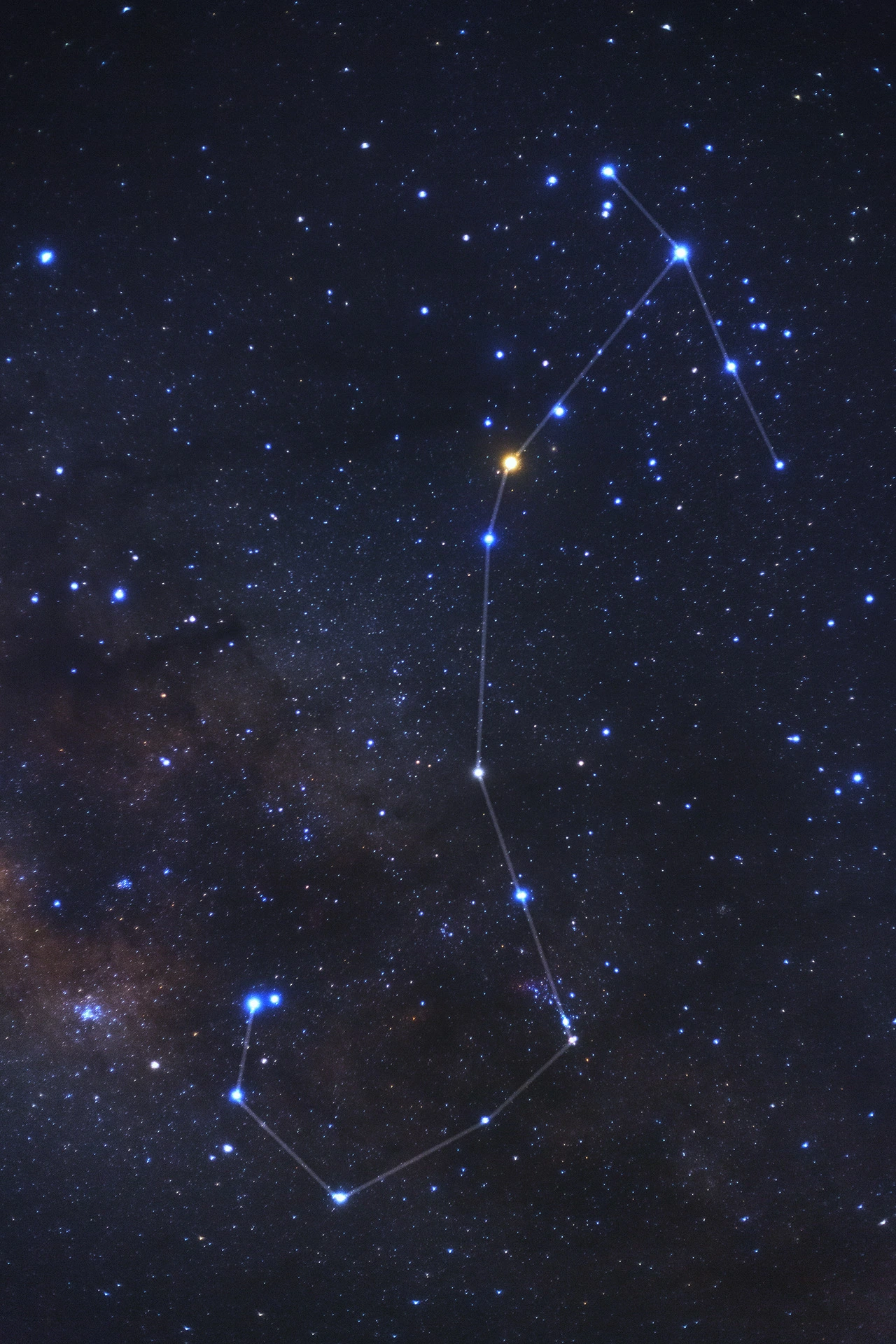
Star Hopping: Ursa Major and Boötes

the Big Bear and the Bear Driver

Read “My Mother is a What?” in Night Sky Stories: Myths of the Northern Sky.

<b>Credit:</b>E. Slawik/NOIRLab/NSF/AURA/M. Zamani
Credit:E. Slawik/NOIRLab/NSF/AURA/M. Zamani

The Big Dipper


Go outside after dark.

Face north.

(To find north, point your left shoulder to the spot where the sun went down. That
is west. The front of your body will be facing north. This is not true north, but the
constellations are big enough to find this way.)

Give your eyes a few minutes to get used to the dark.

Look at all the stars!!

Look for a huge cooking pot with a long, bent handle. See Diagram 1.
Many people call the pot the Big Dipper. It has lots of other names.

Credit: Terri McManus

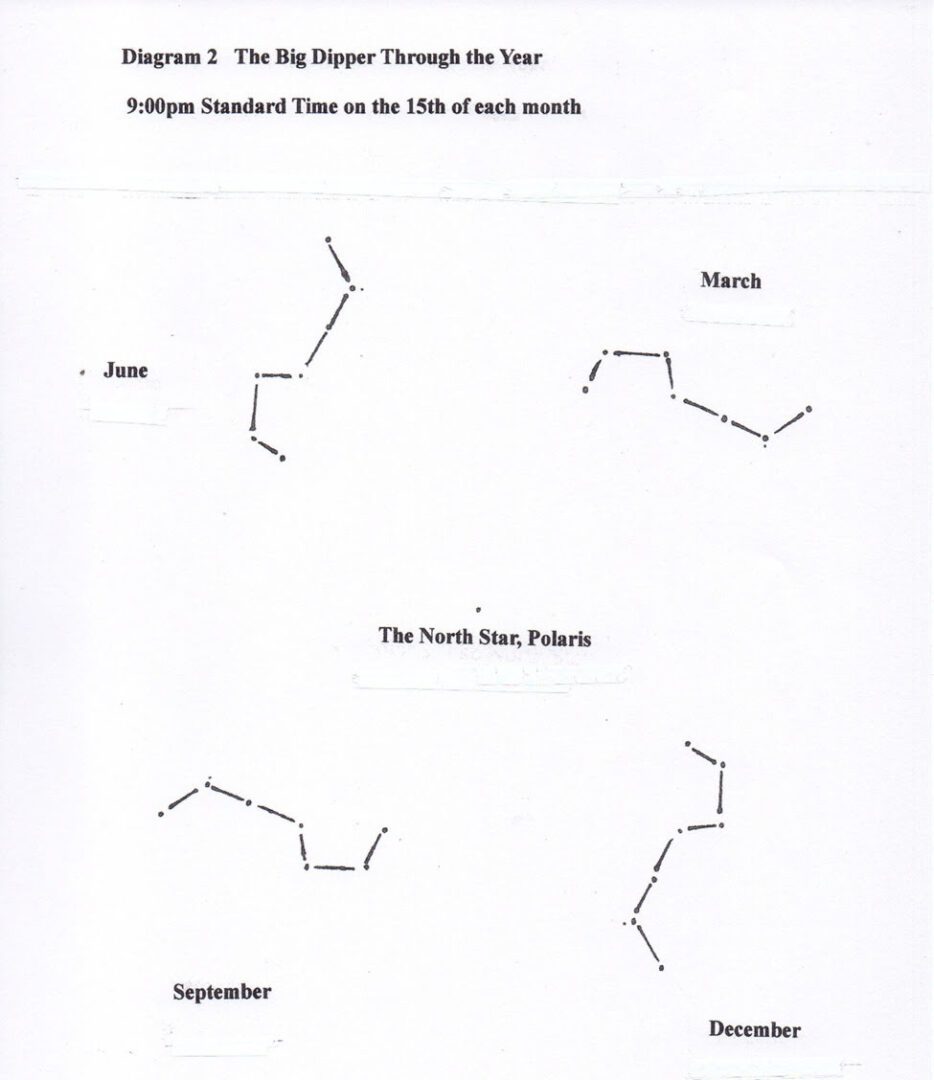
The Big Dipper Through the Seasons

Use Diagram 2 to help you find the Big Dipper through the year.

  • In March: Face north. Look up and to the right. It is in the northeast sky. The pot is upside down. It is empty!
  • In June: Face north. Look high and to the left. The Big Dipper will be high in the northwest sky. It looks like it is spilling something.
  • In September: Face north. Look low and a bit to your left. It is low in the northwest sky. The pot is full.
  • In December: Face north. Look low and to your right. It is low in the northeast sky. It looks like the pot is standing on its handle.

Ursa Major – The Big Bear

Many people think the Big Dipper is the whole constellation, Ursa Major. It is not! The Big Dipper is only part of Ursa Major, the Big Bear.

In the Greek myth, Ursa Major (ER-sa MA-jor) is Callisto, Arcas’s mother, turned into a bear by Hera, queen of the Greek gods. In the Roman story, Ursa Major is Callisto put in the sky by Jupiter to save her from his angry wife, Juno.

Star Hopping: Ursa Major – the Big Bear

We will start star hopping with Ursa Major, the Big Bear, or the Great Bear.

Each letter in Diagram 3 stands for a star. Follow the alphabet to hop from star to star.

In this diagram, the size of the star dots does not show how bright the star is.

You may be able to star hop Ursa Major by using just the diagram. Remember, la lot of the stars are not very bright so it will be hard to see them. It is hard to find them in the city.

  • Start with the Big Dipper.
  • Find the star where the handle meets the pot, D.
  • Go across the top of the pot to A.
  • Go in this line the same distance as the top of the pot.
  • There will be other stars along the way. Keep going in the D to A line.
  • You will know Star I when you see it. It is brighter than the other stars on the path.
  • I is the back of the bear’s neck.
  • Keep going in that same line to the next bright star.
  • This star makes the bear’s nose, J.
  • Go back I to find the star that makes her chest.
  • It is not as bright as her nose star.
  • Move away from I in a line even with Big Dipper’s A and B.
  • You will come to K, her chest star.
  • Her front hip, L, is under her chest star, K. K to L is a little longer than I to K.
  • Next is M, a leg star.
  • Line L-M is her front leg. One leg is behind the other. N and O are her front feet.
  • Her back hip is Star P.
  • Her leg line C-P is almost even with the front hip line K-L.
  • Her back legs split at star P.
  • Star Q is her knee.
  • Stars R and S make a foot.
  • Stars U and T make her other back foot.

Can you find the big bear in the image ?

Photo of the constellation Ursa Major with annotations from IAU and Sky &amp; Telescope. Here is the non-annotated version.

Credit: E. Slawik/NOIRLab/NSF/AURA/M. Zamani

Credit: Terri McManus
Credit: E. Slawik/NOIRLab/NSF/AURA/M. Zamani
<b>Credit:</b> E. Slawik/NOIRLab/NSF/AURA/M. Zamani
Credit: E. Slawik/NOIRLab/NSF/AURA/M. Zamani
Credit: Terri McManus
<b>Credit:</b> E. Slawik/NOIRLab/NSF/AURA/M. Zamani
Credit: E. Slawik/NOIRLab/NSF/AURA/M. Zamani

Star Hopping: Boötes – the Bear Driver

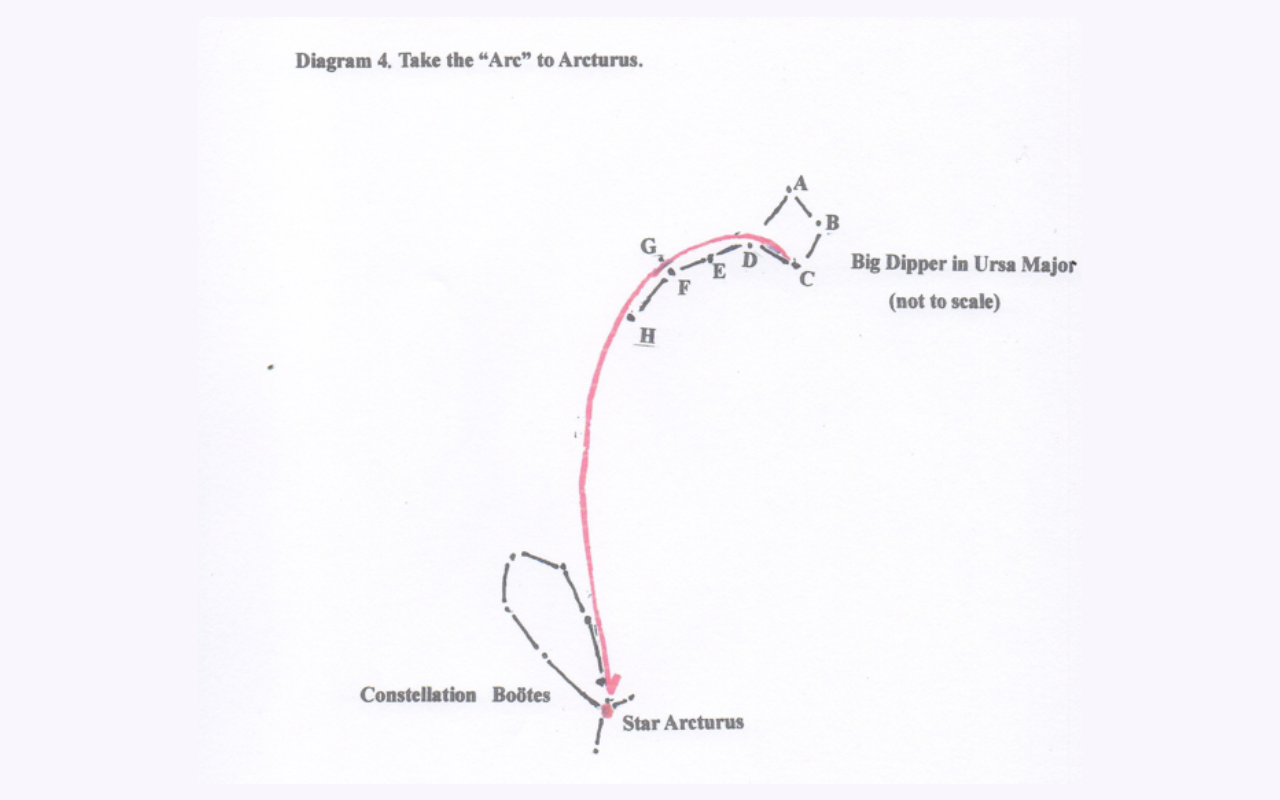
Take the Arc to Arcturus 

Use Diagram 4 to follow the arc to Arcturus (Arc-TUR-us). You might not need to use the directions below.

  • Hop to the Big Dipper. Start at Star C. Hop to D then up the handle to H.
  • Do that again without stopping.
  • That makes a nice curve.
  • Astronomers call that an “arc.” They say, “Take the arc to Arcturus.”
  • Make the arc again but do not stop at the end of the handle.
  • Keep following the curve.
  • You will come to a bright reddish-orange star. That star is Arcturus.
  • It is the brightest star in the constellation Boötes (boo-OH-tēs), the Bear Driver. Arcturus is the fourth brightest star in the sky.
  • Arcturus is Arcas, Callisto’s son in Greek mythology. Read the story My Mom is a What? in the book, Night Sky Stories, Myths of the Northern Skies.
  • The name Arcturus means “bear driver” or “bear guard.”
  • Think, “Arcus keeps the bear going forward.” Arcus walks close to the Big Bear, his mother, to help her.
  • The constellation Boötes, the Herdsman, looks like a kite.
  • Arcturus is the bright star at the bottom of the kite. The fainter stars on either side of Arcturus look like kite ribbons.
  • Star hop to find the rest of Boötes.

Can you find Boötes in the picture?

Star Hopping: Ursa Minor – the Little Bear

Ursa Minor (ER-sa MY-nor) stands for Arcas, Callisto’s son, in Roman mythology. Arcas is the
little bear to Callisto’s big bear. Read "The Two Bears" in the book, Night Sky
Stories: Myths of the Northern Skies.

On with the star hopping!

  • Go outside in the dark.
  • Face north.
  • Find the Big Dipper, Stars A and B.
  • Start at B and move in a line to A.
  • Keep that line going across the sky.
  • The first bright star you come to is Polaris, our North Star.
  • Stars A and B are “The Pointer Stars” or just “The Pointers.” They point to our North Star, Polaris.
  • Polaris is not the biggest star. It is not the brightest star.
  • Polaris is special because Earth’s North Pole points to it.
  • It is always in the same place in the sky.
  • It shows us where north is.
  • Polaris is the brightest star in the constellation Ursa Minor, the Little Bear. It is about the 48th brightest star in the sky.
  • Polaris is the end star of the Little Dipper’s handle. Start star hopping at Polaris.
  • Follow the diagram. You might not be able to see the rest of the handle. The stars are not very bright. Light pollution will make them even harder to see. You may only be able to see the two stars at the end of the bowl and Polaris.
  • Notice in the diagram that some stars are bigger dots than others. Astronomers use the dot’s size to show how bright the star is.
  • Brighter stars have bigger dots on star charts.

Can you find Ursa Major in the picture below?


Photo of the constellation Ursa Minor produced by NOIRLab in collaboration with Eckhard Slawik, a German astrophotographer. Here is the annotated version.

Credit: E. Slawik/NOIRLab/NSF/AURA/M. Zamani

Credit: E. Slawik/NOIRLab/NSF/AURA/M. Zamani

Photo of the constellation Ursa Minor with annotations from IAU and Sky &amp; Telescope. Here is the non-annotated version.
Credit: Terri McManus
draco-ann

Credit: E. Slawik/NOIRLab/NSF/AURA/M. Zamani

img017777

Credit: Terri McManus

Can you find Draco in the image ?

Photo of the constellation Draco produced by NOIRLab in collaboration with Eckhard Slawik, a German astrophotographer. Here is the annotated version.

Credit: E. Slawik/NOIRLab/NSF/AURA/M. Zamani

Star Hopping: Draco – the Dragon

Read Draco’s story, A Dragon’s Tale, in the book, Night Sky Stories: Myths of the Northern Skies.

Are you ready to star hop Draco (DRAY-co), the Dragon?

Draco lives between the two bears.

Find Big Bear – Ursa Major.

Find Little Bear – Ursa Minor.

(Remember to use the Pointer Stars to find Polaris.)

  • Connect Big Dipper Stars C and D with a line. Start at C.
  • Draw that line across the sky.
  • You will come near a shape with four sides.
  • That is Draco’s head.
  • Draco’s body winds between the Big and Little Dippers.
  • Connect the last star in the Big Dipper’s handle (H) to Star A in the Little Dipper’s bowl.
  • You come close to the star Thuban. It was Earth’s pole star about 6,000 to 4,000 years ago.
  • Start at Thuban and star hop to Draco’s head.
  • Go the other direction from Thuban to make the rest of his body and his tail.
  • It looks like Draco hurts.
  • He is not holding his head high. His head is as low as his belly.
  • Star Hopping Cassiopeia, Cepheus, Andromeda, Perseus, and Cetus

Star Hopping: Cassiopeia– the Queen

Read “Cass Tells All” in Night Sky Stories: Myths of the Northern Sky.

Are you ready for more star hopping?

Let us find the constellation, Cassiopeia

(Ka-see-e-oh-PEE-uh).

  • Look north.
  • Find the Big Dipper.
  • Hop to Polaris.
  • Keep hopping in the same direction.
  • Now….see the BIG “W’ in the sky? It looks a little lazy on one side.
  • Your line will come close to the W.
  • Queen Cassiopeia is the Big W on the other side of Polaris from the Big Dipper. She moves around Polaris just like the Big Dipper.

The W could look like a W, E, 3, or an M. It does not matter if it looks like
a W, an E, a 3, or an M. People still call it the “W.”

Queen Cassiopeia

Queen Cassiopeia sits in a basket.

Some people say she sits on a chair.

Others say she sits on her throne.

Sometimes she is upside down.

Hold on tight Cassiopeia!

Photo of the constellation Cassiopeia with annotations from IAU and Sky &amp; Telescope. Here is the non-annotated version.

Credit: E. Slawik/NOIRLab/NSF/AURA/M. Zamani

Credit: Terri McManus

69c514b52d221_img042 (1) 1

Can you find Cassiopeia in the picture below?

Photo of the constellation Cassiopeia produced by NOIRLab in collaboration with Eckhard Slawik, a German astrophotographer. Here is the annotated version.
Photo of the constellation Cepheus with annotations from IAU and Sky &amp; Telescope. Here is the non-annotated version.

Credit: E. Slawik/NOIRLab/NSF/AURA/M. Zamani

Credit: Terri McManus

Credit: Terri McManus

1232

Credit: Terri McManus

Star Hopping: Cepheus- the King

We will hop over to Cepheus (SEE-fee-us) next.

Cepheus is between the “Big W in the Sky” and Draco, the Dragon.

Look between them to find Cepheus. See Diagram 8.

Cepheus looks like a house in the sky.

He is also a pentagon, a five-sided shape.

King Cepheus sits on his throne.

He is wearing a pointy hat.

King Cepheus

  • Here is another way to find King Cepheus. See Diagram 9.
  • Use the Big Dipper’s Pointer stars to get to Polaris.
  • Hop past Polaris still following the Pointers’ line.
  • You will come close to the star at the point of Cepheus’s hat.
  • That star is the top point of the house.
  • Keep going with that same line.
  • That line goes right through Cepheus’s hat.
  • It passes close to a star that makes the top corner of the wall of the house (or the bottom of King Cepheus’s hat).
  • Make a line with star Caph (in Cassiopeia, top star on the western edge of the W) and the bottom star on the same side.
  • Follow these two stars and head to Cepheus.
  • You will go right between the two stars that make the bottom of the walls.

Cepheus changes as it goes around Polaris. See Diagram 10.

The house is upright. The house falls onto its side.

Then it is upside down. Then it falls onto its other side.

Then it is back to an upright house.

The star Delta Cephei is a variable star.

That means it changes how bright it is. Its pattern is always the same – 5.4 days

to go from dimmest to brightest and 5.4  days to go back to dimmest. It is so

predictable that it is used to tell how far away other stars and galaxies are.

Can you find Cepheus in the picture below?
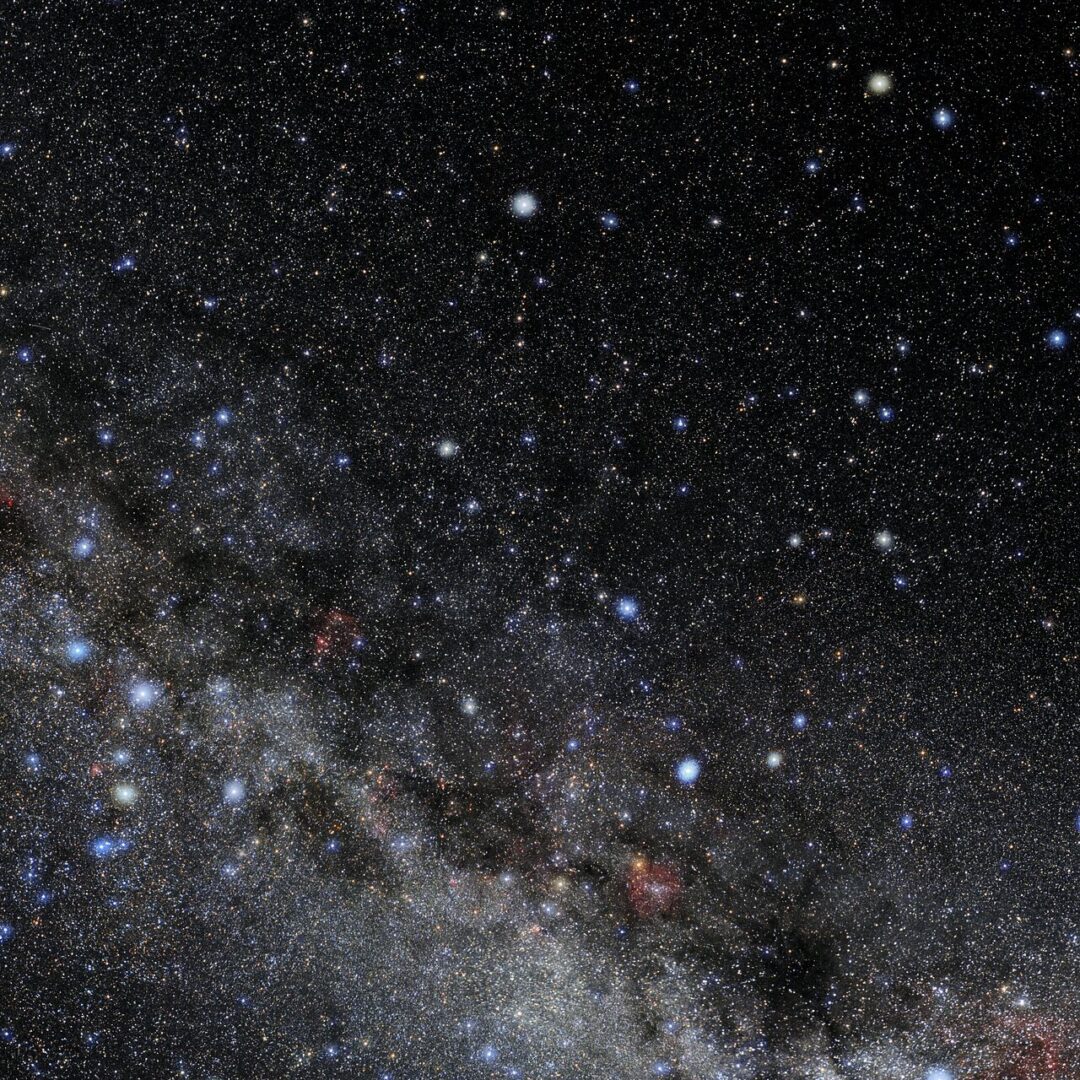
Photo of the constellation Cepheus produced by NOIRLab in collaboration with Eckhard Slawik, a German astrophotographer. Here is the annotated version.

Credit: E. Slawik/NOIRLab/NSF/AURA/M. Zamani

Star Hopping: Andromeda – the Princess

Ursa Major, Ursa Minor, Draco, Cassiopeia, and Cepheus are circumpolar constellations. They go around Polaris. They never go below the horizon, where the sky meets the land. You can see them all year.

The constellations Andromeda (an – DROM – e-da), Perseus and Cetus are NOT circumpolar. You cannot see them every night of the year. You see them best in Autumn. They are here because they are part of the Cassiopeia-Cepheus Story.

Let's star hop to find Andromeda.

  • Face north.
  • Find Cassiopeia’s “W “ overhead.
  • Use the two stars on the “upright, not the lazy end of the “W.”
  • Hop away from Cepheus.
  • Keep going in that line.
  • You meet two stars.
  • You meet the dimmer star first.
  • The brighter one is a little beyond the dimmer one.
  • Each star is the end of a line of four stars.
  • Follow each of the lines to the end.
  • Both lines end at the same star!
  • This star is Andromeda’s head.
  • The two lines make her body.
  • Imagine Andromeda chained to the rocks.
  • She is waiting for Cetus, the Sea Monster, to come for her.
  • Another way: Look for a big square, The Great Square of Pegasus.
  • Make a line with Cepheus’s bottom two stars. Follow that line away from Draco. The line will take you to the square.
  • The constellations Pegasus and Andromeda share a star at a corner of the square.
  • That star is Andromeda’s head.
  • Two lines of three stars come from her head.
  • The two lines of stars are Andromeda’s body and legs.
Photo of the constellation Andromeda with annotations from IAU and Sky &amp; Telescope. Here is the non-annotated version.

Credit: E. Slawik/NOIRLab/NSF/AURA/M. Zamani

69c514b496148_img045 1

Credit: Terri McManus

Rectangle 1430
3232

Credit: Terri McManus

Star Hopping:The Andromeda Galaxy

  • Constellation Andromeda is home to the Andromeda Galaxy.
  • The Andromeda Galaxy is about 15,000,000,000,000,000,000 miles (15 quintillion miles!) from Earth!
  • It is the major galaxy closest to us.
  • You can see the Andromeda Galaxy on clear, dark nights. No moon and away from lights works best. Late fall is the best time to see it.
  • To find the Andromeda Galaxy, start at Andromeda’s head.
  • Two lines of stars make Andromeda.One line is brighter than the other. Both lines have the same beginning star, Andromeda’s head. Hop to the first star on the bright line of stars.
  • Hop to the second star in the bright line. That is “Hop two.”
  • Hop to the dimmer star right above “Two.”
  • Notice how far apart the two lines are at “Two.”
  • Hop away from the top star line the distance they are apart.
  • You should be able to see a “fuzzy patch.” Yes, astronomers do use the word “fuzzy patch.”
  • Astronomers use a trick called averted vision when looking at faint objects.
  • Do not look right at the object but look close to where you think it is.
  • You may see it pop into view. You will see more detail than if you look straight at it.
  • You can see the Andromeda Galaxy with binoculars. It won't be spectacular like the picture.
  • You will see a fuzzy patch. It will not look like the big picture.


Can you find Andromeda and the Andromeda Galaxy in the picture below?

Credit: E. Slawik/NOIRLab/NSF/AURA/M. Zamani

Star Hopping: Perseus – the Hero

Remember - Ursa Major, Ursa Minor, Draco, Cassiopeia, and Cepheus are circumpolar constellations. They go around Polaris. They never go below the horizon (where the sky meets the land). You can see them all year.

Perseus (PUR-see-us) is also NOT circumpolar. You might see two to four of the stars of Perseus when Cassiopeia is low in the northeast. The rest of Perseus is below the horizon. Autumn is also the best time of year to see Perseus.

Are you ready to star hop Perseus?

Find Cassiopeia.

The shortest part of the “W” points to Perseus. Diagram 12

Perseus also has a variable star. It is not the same kind of variable star as the
one in Cepheus. Algol dims because another star goes in front of it. Algol gets
dimmer every 2.87 days. It stays dim for two hours. Then Algol gets brighter. It is
like Algol is winking!

54646-scaled

Credit: Terri McManus

Credit: E. Slawik/NOIRLab/NSF/AURA/M. Zamani

Photo of the constellation Perseus with annotations from IAU and Sky &amp; Telescope. Here is the non-annotated version.

 Can you find Perseus in the picture below?

Photo of the constellation Perseus produced by NOIRLab in collaboration with Eckhard Slawik, a German astrophotographer. Here is the annotated version.
Photo of the constellation Cetus with annotations from IAU and Sky &amp; Telescope. Here is the non-annotated version.

Credit: E. Slawik/NOIRLab/NSF/AURA/M. Zamani

26125612

Credit: Terri McManus

Photo of the constellation Cetus produced by NOIRLab in collaboration with Eckhard Slawik, a German astrophotographer. Here is the annotated version.

Star Hopping: Cetus – the Sea Monster

Poseidon, the god of the sea, sent Cetus, the Sea Monster, to destroy King Cepheus’s and Queen Cassiopeia’s kingdom.

Look for Cetus in December.
You will need a dark place.
Most of the stars are not very bright. They may be hard to find. Light pollution will not help!

Look at Diagram 12. Cetus looks like a man with no arms, but not a sea monster!
Play dot-to-dot with his legs to make the sea monster’s body.
Now you have a sea monster with a pentagon for his head, a very long neck, and a small body.

To Find Cetus:
Start at the top of Perseus’s head.
Go down the long side of this body.
Follow the curve just like you did to find Arcturus.
You will come to a cluster of stars that looks like a “Little, Little Dipper!”
It is called The Pleiades. They are a group of sisters.
How many stars can you see? Try your averted vision.

Back to finding Cetus:
Start at Perseus’s long leg. Follow the curve past the Pleiades.
You come to Cetus’s pentagon head.
One star is brighter than the rest, Menkar.
What color is it? Do you see a faint red?
Menkar is a kind of star called a red giant.
Red giants are big, big, big stars.
They are not the hottest stars. They are cooler stars.
Red giants are very old stars.

There is a star about halfway down Cetus’s neck you might or might not see.
It is Mira, the Wonderful.
Mira is always there. Sometimes it is not bright enough to see.
Mira is a variable star like Delta Cephi in the constellation Cepheus.
It gets brighter, then dimmer, the brighter, then dimmer.
Mira takes about 332 days to go from brightest to dimmest.
If you saw it at its brightest, you would have to wait about another 664 days to see it at its brightest again!
Mira was the first variable star ever seen.
Mira is also a red giant like Menkar.
It gets bigger, then smaller, then bigger, then smaller, then bigger, then . . .
It is brightest when it is biggest.
Mira is another kind of variable star.
It changes its brightness by getting larger then smaller. Mira was the first variable star ever seen.